
What our customers are saying
Thoughts about our service
What was purchased
READ ANOTHER TESTIMONIAL
See what people are saying about Rattlesnake! Over 2400 testimonials and growing!
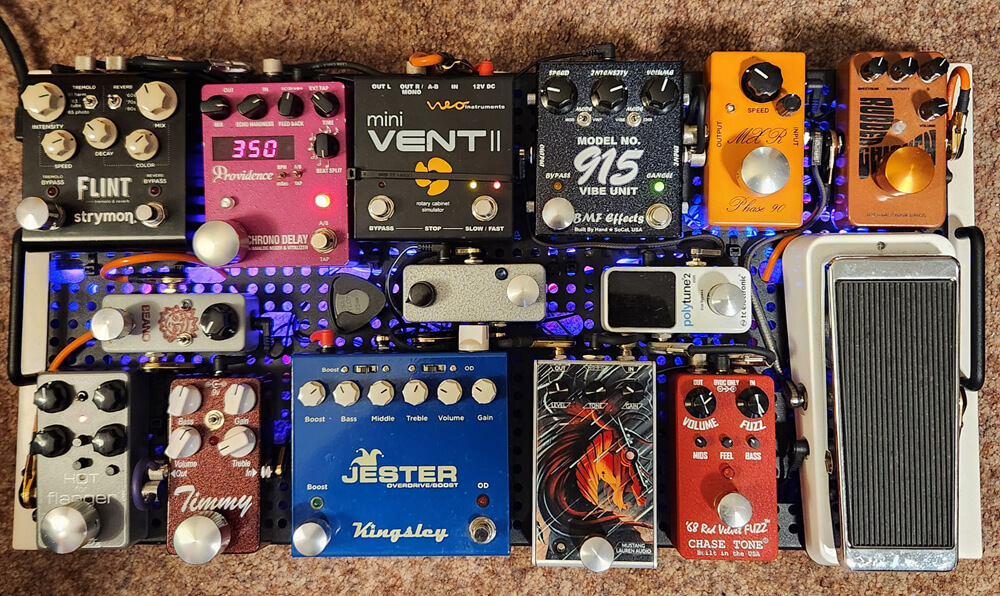
I am a huge pedal nerd. After years of buying, selling, and trading, I have finally settled on the effects that are here to stay for the long haul. I'm from the school of thought that pedals should augment and enhance the amps through which they are played, and as such, I design my gigging pedalboards around the amps that they'll be mainly utilized with.
I have one board that's designed for lower-wattage amps that does most of the heavy lifting for my base tone, and another—the one pictured here—typically for use with mostly-clean amps set just on the edge of breakup (usually in the blackface Fender-style amp camp).
My band, Foolish Pride, plays a hearty mix of "Southern-fried" classic rock, blues, and psychedelia, with dueling lead guitars and a lot of mojo. I'm usually playing a Les Paul, SG, or Firebird.
I use Temple Audio pedalboards, in this case a Duo 24, equipped with a patch bay module at the beginning of my signal chain, and a buffered "stereo sum" module at the end of the chain, which enables me to sum stereo pedals into mono if using one amp live, or to easily run in stereo if using two amps, and also to further drive my signal. There's also a direct input module that is linked through the back of the stereo sum box so that I can run my pedals directly to a mixer, if desired, in tandem with my amps. I also have some Temple Audio LEDs under my board to illuminate my board on stage. Everything is powered by a CIOKS DC-7 and CIOKS Hi5 power supplies.
Starting with the patch bay, my signal chain first hits an Analog Man Beano Boost treble booster (which needs to be first in-line to work best), which I use for pushing some of the fuzzes and drives further down the chain a little harder and bring some cool, hairy textures to my tone.
The Beano then runs into a Lovepedal Rubber Chicken Auto-Wah. I've tried a lot of auto-wahs and envelope filters, and I find myself often coming back to the simple delights of the Rubber Chicken for getting that quacky filtered sound in a small package. The Rubber Chicken then runs into an Xotic Effects XW-1 Wah, which is my all-time favorite wah for its tweakability and killer tones. With side knobs for adjusting the frequencies, I find it to be just delightful, and I've been rolling with at least one for almost a decade now, after trying numerous other wahs (I use a Joe Gagan Italia V2 wah on my smaller board, which is also a tasty wah in its own right).
The XW-1 Wah then feeds into an MXR Custom Shop '74 Phase 90 that was modded by Analog Man to include an LED, power jack, external mix knob, internal volume knob, and true bypass. The Phase 90 is just a classic sound, and I tend to like phasers and vibes before dirt.
Accordingly, the next pedal in my chain is a BMF Effects 915 Vibe. For its size and price point, I haven't found a univibe type of pedal that is as satisfying for my needs (without dropping serious cash). It's lush, chorusy/phasey, with just the right chewiness to bring some swampiness to my rig when engaged (typically when my band plays "Breathe" by Pink Floyd, and "When the Levee Breaks" by Led Zeppelin).
Next up is a TC Electronic Polytune 2 Mini. Yes, yes, I'd ideally like to park it earlier in the chain, but on a tight board with patch cables (from Lava and Rattlesnake) running every which way, over and under the board to try and make everything as neat as possible, this was the soonest I could get it in the chain where it fits neatly into the flow (and besides, I don't usually have any of the preceding effects engaged when I use it). The tuner also doubles as a signal muter, which I sometimes use to mute the board's output when changing guitars mid-set.
After the tuner, the signal hits a Chase Tone '68 Red Velvet Fuzz, a fuzz face inspired circuit with BC-183 transistors. I like it for its range of tones from smooth to gritty, with controls for the low end and mids presence being very intuitive.
Next, is the Lauren Audio Mustang GT, which is based on the Neve console preamp. I use this one as kind of a fuzz drive, for songs that need a little extra grit and sag in their base tone.
Following the Mustang GT is the tonal centerpiece of the pedalboard: a Kingsley Jester V2, with sizzle knob, which is a tube-based overdrive that I use as my foundational overdrive when using a cleanish amp. The Jester is handy in that it not only has a killer overdrive sound; it has a separate switch for boosting, which can be used independently, if desired, and I use it as my clean boost when needed.
Following the Jester is a Tungsten Amplification Transistor Boost No. 2, which I use to fatten up my tone, or to add a slightly fuzzy low-end boost. It's a great, simple one-knob pedal with lots of juice. For most of my solos, lead work, and general signal boosting, though, the next pedal in my chain does a lot of work at every gig: my beloved Paul Cochrane Timmy V2. I run the Timmy at 18 volts for more headroom. I've owned many boosts, but the Timmy V2 has stuck with me for over a decade and has worked wonders with almost every setup I've ever thrown at it. I have one on each of my pedalboards—it is an essential part of my lead guitar sound.
Next up in my chain is my modulation section, which is generally the only slot that I sometimes change, depending on my mood. The Australia-based boutique pedal company, PastFx, has mastered several old, discontinued vintage circuits and improved upon them, and thus PastFx pedals have become my go-to for modulation sounds.
I typically use a PastFx Hot For Flanger (based on/ an expansion of the MXR 117 grey box flanger) or my favorite overall modulation pedal ever, the PastFx Elastic Mattress (based on/ an expansion of the late ‘70s EHX Electric Mistress), both which run on 18 volts. Sometimes I even drop in a PastFx Kurt's Cologne chorus (a wickedly clever take and expansion on the Small Clone), also at 18 volts.
The modulation slot is then followed by a Neo Instruments Mini Vent II, which I use for rotary simulation, which always turns heads whenever it is engaged! I like it in slow mode, but the real magic is when it's ramped up to fast speeds. Like a good spice, I use it sparingly, but always tastefully whenever it is called upon.
Following the Mini Vent II, my signal hits my favorite digital delay, the Providence Chrono, which is feature-rich but very easy to use. I love that it has an A/B switch where I can alternate between preset delay times (usually 150ms and 350ms, but it can go up to nearly 2 full seconds, if desired). Like the Timmy, I have a Chrono on all of my pedalboards and I consider it one of the essential pieces of my tone. It also has a great buffer in it.
Finally, the last spot on my board is dedicated to tremolo, one of my favorite effects. I've dropped several contenders into that spot—I have a Hamstead Signature Tremolo on my smaller board that I like a lot—but the good ol' Strymon Flint V1 covers my gigworthy tremolo needs, with the added bonus of reverb if I want to supplement or add to whatever I'm getting from my amp(s). The Flint then feeds to the aforementioned stereo sum module for routing my signal to the Rattlesnake cables that await it!
About a million years ago, I used to run a blog called EffectsBay. On that blog, the most popular feature I would run was Pedal Line Friday. This is where readers of the site would send pics of their pedalboard and a short (sometimes long) write-up of routing and thoughts about specific pedals and the reasoning why they liked it, etc. Readers. loved this. It was a great way to learn about new applications or techniques regarding pedals. It also brought a little inspiration and knowledge about pedals you were not familiar with. It also brought a great sense of community - people like sharing and absorbing cool things, right? It was a super popular feature, and I loved putting them together.
All you have to do is send a pic of your pedalboard (or pedal line - it doesn't have to be on a board) along with a short (or long) write-up of the board. We want a list of pedals (manufacturer/model), routing would be great, and, most importantly, why you use those particular pedals. Also, this is a great way to promote your band or musical project - include that information as well!
You can send the pic and the write-up to pedalline@rattlesnakecables.com.


Chris in Niles MI just submitted a custom loom request!
about 9 hours ago
Todd in Troy NY just made a purchase!
about 2 hours ago
Adam in Grand Forks ND just made a purchase!
about 5 hours ago
Peter in Palmetto FL just submitted a custom loom request!
about 8 hours ago
Landon in Las Vegas NV just made a purchase!
about 2 hours ago
Curtis in Salem OR just made a purchase!
about 2 hours ago
Mark in Ada MI just made a purchase!
about 5 hours ago
Dave in Crest Hill IL just made a purchase!
about 21 minutes ago
Bob in Port Orchard WA just made a purchase!
about 1 hour ago
Rob in Poway CA just made a purchase!
about 8 hours ago