
What our customers are saying
Thoughts about our service
What was purchased
READ ANOTHER TESTIMONIAL
See what people are saying about Rattlesnake! Over 2400 testimonials and growing!
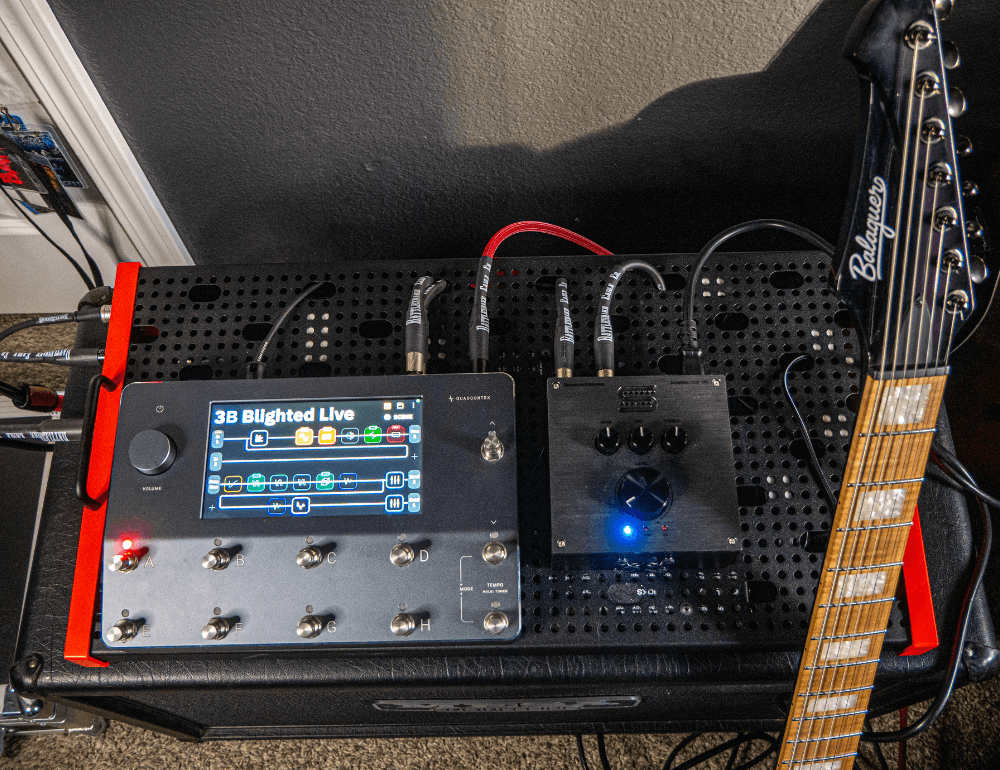
Well, this is about as simple as it gets. Every year I’ve been trimming my live rig down more and more, cutting clutter and making setup/teardown easier without sacrificing any tonal flexibility. That process has taken me from fully packed racks to what you see here today. At this point, barring the addition of a wireless unit in the blank space on the right side of the board, this is pretty much all I need.
Before getting into the pedals, let’s start with the real reason for the season: the cables, all provided by Hank and the wonderful folks at Rattlesnake Cable Company. Everything on the board is wired using Rattlesnake’s 2’ jumper patch cables with Neutrik nickel connectors. I wanted something heavy-duty that wouldn’t flex or fail but could still be wrangled into all the tight ins and outs on the board, and these fit the bill perfectly.
From the board to my cab, I’m using a 30’ speaker cable with black Switchcraft 188 ¼” connectors, along with a custom 30’ loom featuring a 5-pin MIDI and a TRS cable with gold Neutrik connectors in red. I also run a 10’ instrument cable to whichever Balaguer guitar I decide to bring on the road.
Now onto the pedalboard itself. Pedal one of two is a Neural DSP Quad Cortex (there are many like it, but this one is mine). It’s become pretty standard fare for touring bands these days. I picked mine up in early 2021 and have been using it live since 2022, taking it around most of the country with my bands Aethereus and Blighted Eye. The patches are fairly similar for both projects: rhythm, digi-delay lead, overdrive, clean 1 (more verb and delay), rhythm with verb, lead with verb, tremolo lead, and clean 2—a more psychedelic-leaning clean with a bit of delay and phasing.
Send 1 runs my main chain to the power amp, while Send 2 includes a cab impulse and feeds my in-ears and FOH.
Pedal two of two is the Seymour Duncan PowerStage 170. While I can send a fully processed DI signal from the Quad Cortex straight to FOH, I’ve always felt something gets lost when you remove a physical cabinet from the equation (a certain “oomph,” if you will). I like to feel air moving on stage, and I’ve found the same is true as an audience member. Unless a venue has an exceptional PA, a fully DI setup without a cab just doesn’t hit as hard.
There’s also the practical side: many venues are still very DIY, and not every venue has the flexibility to handle a bunch of additional outputs beyond the essentials. Being as plug-and-play as possible goes a long way. For small to mid-sized rooms, the PowerStage has more than enough juice to push a 2x12 or 4x12, and the onboard 3-band EQ is great for quick room adjustments.
Everything is mounted to a Temple Audio Duo 24, which I absolutely love. It’s sturdy, easy to transport, and incredibly modular thanks to the side mods. On the right side, I have the IEC power mod feeding a CIOKS DC7 and CRUX mounted underneath. On the left, there’s a 2X mod with two ¼” outs; one to my cab and one to our rack/mixer for IEMs and FOH. Just above that is a 5-pin MIDI DIN mod connected to the Quad Cortex for automated patch changes.
At this point, some of you might be asking, “Kyle, if your patch changes are automated, why even bother with a pedalboard?” There are two simple reasons. First, this rig is incredibly easy to travel with (it’s basically the size of a small carry-on and fits comfortably in a van or overhead compartment).
More importantly, it’s about redundancy. Technology is amazing when it works, and a nightmare when it doesn’t. Anyone who’s played a gig with a laptop knows how quickly a bad connection or firmware hiccup can derail a set. Rather than letting something like that ruin a night, I’ve built this rig so I can switch to manual mode and do some good old-fashioned tap dancing if needed.
That about covers it! I’m incredibly grateful to be a part of Rattlesnake’s Artist Program and am excited to get some more cables built in the coming months!
About a million years ago, I used to run a blog called EffectsBay. On that blog, the most popular feature I would run was Pedal Line Friday. This is where readers of the site would send pics of their pedalboard and a short (sometimes long) write-up of routing and thoughts about specific pedals and the reasoning why they liked it, etc. Readers. loved this. It was a great way to learn about new applications or techniques regarding pedals. It also brought a little inspiration and knowledge about pedals you were not familiar with. It also brought a great sense of community - people like sharing and absorbing cool things, right? It was a super popular feature, and I loved putting them together.
All you have to do is send a pic of your pedalboard (or pedal line - it doesn't have to be on a board) along with a short (or long) write-up of the board. We want a list of pedals (manufacturer/model), routing would be great, and, most importantly, why you use those particular pedals. Also, this is a great way to promote your band or musical project - include that information as well!
You can send the pic and the write-up to pedalline@rattlesnakecables.com.


Peter in Palmetto FL just submitted a custom loom request!
about 8 hours ago
Todd in Troy NY just made a purchase!
about 2 hours ago
Adam in Grand Forks ND just made a purchase!
about 5 hours ago
Mark in Ada MI just made a purchase!
about 5 hours ago
Rob in Poway CA just made a purchase!
about 8 hours ago
Chris in Niles MI just submitted a custom loom request!
about 9 hours ago
Dave in Crest Hill IL just made a purchase!
about 21 minutes ago
Landon in Las Vegas NV just made a purchase!
about 2 hours ago
Bob in Port Orchard WA just made a purchase!
about 1 hour ago
Curtis in Salem OR just made a purchase!
about 2 hours ago