

What our customers are saying
Thoughts about our service
What was purchased
READ ANOTHER TESTIMONIAL
See what people are saying about Rattlesnake! Over 2300 testimonials and growing!
A question this often asked is, “What is the difference between a TRS and a TS cable?” This is a frequent question and has a lot of information associated with it. We wanted to provide some answers to some of the most common questions surrounding this simple yet complex topic.
We thought the best approach was to break down the various questions we get since there are several angles to the answer.
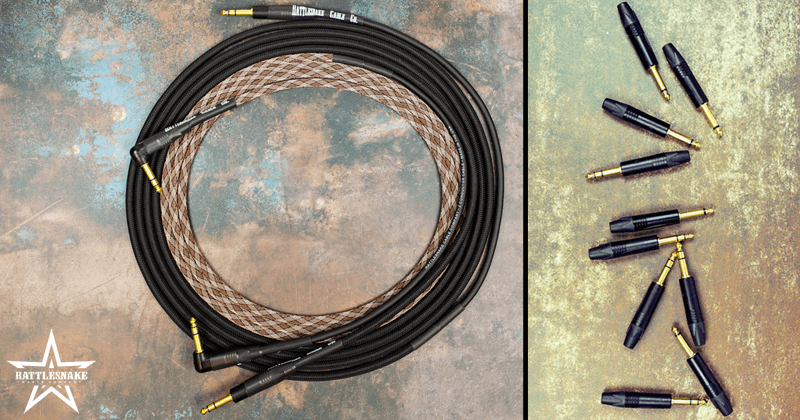
The first fundamental to understand is that the underlying cables are different. We'll definitely get more into details further in the article, but in the most basic explanation, a TRS Cable has two conductors, whereas a TS Cable (also known as - Instrument cable, guitar cable, bass cable, patch cable, etc) has a single conductor internally. Both are protected with copper outer shielding to protect from RF noise. The number of conductors
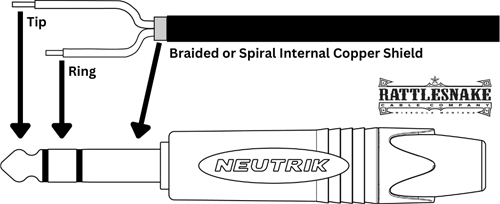
TRS Cables themselves do not determine if the signal is balanced or not. This is handled via the hardware interface, but the cable provides the proper conductors to perform the balanced requirement if needed from the interface. To have a balanced signal, the cable will need to have three conductors (including the shield). A Dual Conductor cable consists of a Tip, Ring, and Shield. Where a TS only has Tip and Shield. The cable becomes balanced when two of the same signals are sent on both positive (+ / tip / hot) and negative (- / ring / cold) lines of the cable. Note, that the two signals are the same, except flipped 180 degrees - so out of phase of each other. This process of sending duplicate signals out of phase is what creates noise canceling.
TRS Wire Diagram
Again, I want to stress that the hardware creates a balanced signal. If you plug a TRS cable in an unbalanced output (like a mono out on a guitar, etc). It does not convert the signal to a balanced signal.
An unbalanced cable only runs down a single line of the cable, creating a mono signal. So, a TRS cable could be used as an unbalanced/mono cable (but not recommended).
An XLR mic or microphone cable can use the same Dual Conductor cable but uses a different set of plugs to terminate the connection. The principal is the same as a typical TRS balanced signal where two duplicate signals are sent out of phase. A TRS to TRS cable can be XLR (male) to XLR (female) or can be a combination of TRS and XLR plugs. These are often used for balanced monitor cables for sending audio signals to powered monitors.
A Dual Conductor cable can be used to send a stereo signal. That means it's sending signals for Left and Right down a single cable. Left and Right can be assigned to either Tip or Ring depending on the wiring of the TRS jack. A stereo signal is not a balanced signal since the signals are not duplicates. Again, a balanced signal is a duplicate signal but out of phase. A stereo signal will carry left and right signals from the stereo field - so they are not duplicates. There are many applications for using a TRS cable to carry stereo or separate signals down a single cable.
Technically, yes, but it's not ideal. It also depends on the instrument's electronics. Many active electronics will not work since they need to confirm that the ground is on the ring of the jack. Technically, the signal will travel down the tip line of a TRS cable, but there could be additional noise and cable capacitance. It is always recommended to use a mono/unbalanced cable for mono instrument outputs.
An interesting fact - especially with bass players that use basses with active electronics (or guitarists that have active setups as well). These will often not work and pass no signal whatsoever unless you have the option to switch to passive. The reason is with active electronics, there is a requirement for a battery to power the active circuit. To conserve the battery's power, the instrument is often equipped with a stereo/TRS jack. The tip works as expected, and so does the shield, but the ring is required to connect to the ground for the circuit to function. That is the 'check' for the battery. A standard TS plug would connect that ring to the shield and complete the circuit. With the TRS, the ring would be 'floating' and basically tell the circuit that nothing is plugged in, and the circuit will not power. No power means no signal.
Here is an example of an email we received with this exact situation:
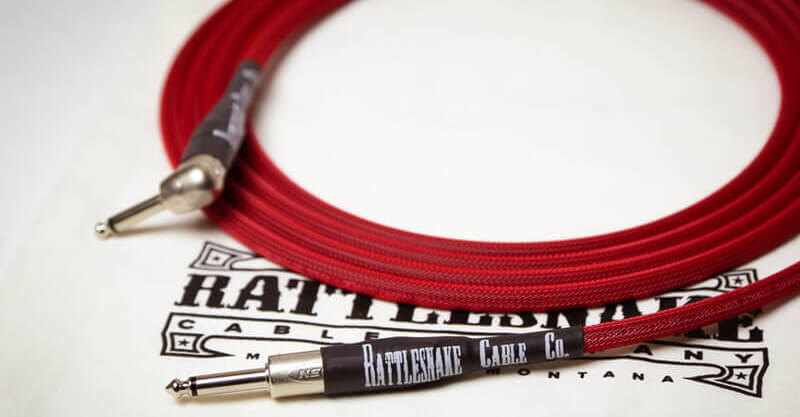
"Two of them are identical (except the color) - the blue one works with both of my amplifiers, but the red one doesn't work with one of my amps (unless the bass is switched to passive mode). Strange, right? And this is true with several of my basses - doesn't work with active mode. So I can use the blue Rattlesnake cable for either amp, but the red one only works with my smaller amp or with the bass set to passive mode."
The Red cable in question was a Stereo Cable.
TRS cables have multiple applications. Typically, they are used to carry balanced signals for longer cable runs and to provide noise cancellation. Long-run TRS (or XLR) is often used from DI boxes to front-of-house connections. TRS cables with XLR plugs are used for microphone signals for live and recording applications. Many powered monitors from interfaces or recording consoles require a TRS cable for sending a balanced signal for the audio.
Some instruments utilize stereo output from pickups, providing dedicated pickup outputs on their individual lines (see Rick-O-Sound). Some amp effects loops use a TRS cable for send/return on tip/ring in conjunction with a TRS splitter box. Any time you need two signals in a single cable, a TRS cable is often the answer.
TRS cables are used any time when there is a need for a pair of balanced signals - typically sending signals to powered monitors or interfacing with mixers. Or there is a need for separated signals in a single cable (stereo signals or split independent mono signals - like effects loops or separated pickups).
Some guitar pedals prefer a TRS jack for stereo (Left/Right) instead of using two separate mono jacks. One jack utilizes much less space than two jacks. When faced with this situation, you may need to use a splitter, like our TRS to Dual Mono Splitter, to split the stereo signal to separate mono signals, or in reverse, have two separate mono signals feed into a single stereo input of a pedal. Just like these pedals, some amps prefer a single TRS for their effects loop for their Send and Return.
This is a mistake that is often made. A player might accidentally grab a TRS cable instead of their standard TS cable. As mentioned above, it will work in most cases, but for the best application, you should use the correct cable. To simply see if the cable/plug is a TRS or TS, look at the plug post. A TS has a single band (or separator) separating the tip from the shield (post). A TRS will have two bands separating the tip from the ring and the ring from the shield.
TRS Jack Plug vs TS Jack Plug
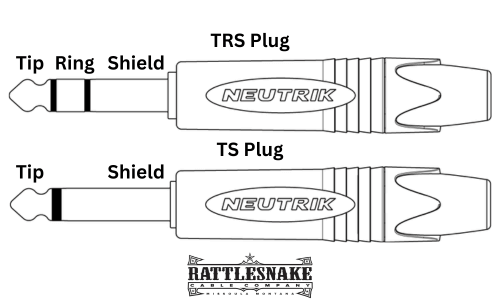
Stereo Plugs come in a few dimensions. Typically, 1/4" is the most common for professional audio applications.
TRS connector dimensions:
1/4" Plug or Jack - Metric value: 6.35mm
1/8" Plug or Jack - Metric value: 3.55mm
This is a common mistake many people make. There is a difference between a Tip / Ring / Sleeve audio jack and a Tip / Ring / Sleeve audio plug. The jack is the receiver of the plug and is usually fastened to something stable - like a pedal enclosure, console, or electronics cavity of a guitar or bass. The plug is fastened to the cable and is designed to be inserted or removed.
A TRS Jack contains three conductors similar to a TRS audio cable where hook-up wires would be connected to lugs. These lugs are a part of the contacts making connections to the particular areas of the plugs. The tip lug touches the tip of the plug, the ring lug touches the ring, and the overall shield lug touches the shield/ground area of the plug.
TRS Jack Diagram
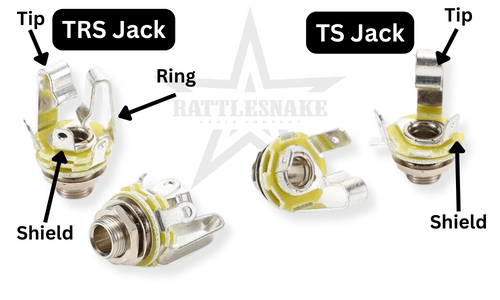
Unfortunately, it is very hard to determine if the jack is a TRS or TS when it's installed. A visual inspection of the internal jack may be the easiest method. But you can also ‘feel' the clicks as a plug is inserted into a jack. Two clicks would indicate a TRS jack and a single click would be a TS jack.
TRS cables work by having two separate conductors insulated from each other in a single cable wrapped in an outer shield or ground. Our Rattlesnake TRS cable uses a pair of 20AWG insulated wires for +/- signals. Both of these wires are surrounded by a copper shield to prevent RF penetration. Separate signals or duplicate signals +/- can be sent down the wires, and the ends are terminated with TRS plugs (Tip / Ring / Shield) plugs. We like to use Neutrik TRS plugs or our RCC TRS Pancakes for TRS patch cables.
To determine if a TRS is working, it is always a great idea to own a cable tester of some sort. Or at least own a multimeter with a continuity tester. A TRS not working properly in a balanced signal situation could be noisy, or you notice a drop in volume. That could indicate that one of the balanced lines is damaged or no longer connected. If the TRS cable is used in a Send/Receive (effects loop) or Left/Right (stereo effect), you would notice a complete failure or loss of signal on one side. If you use a TRS to pass multiple signals from your instrument (Rick-O-Sound), you might only get a signal from one pick-up. Again, you might want to ensure that the cable is a TRS and not a TS cable - and do a final check with a cable tester.


Austin in Morgantown PA just made a purchase!
about 6 hours ago
Zhulian in Tirana 11 just submitted a custom loom request!
about 4 minutes ago
John in Emeryville CA just made a purchase!
about 20 hours ago
Mike in Bethesda MD just made a purchase!
about 20 hours ago
Michael in Glendale AZ just made a purchase!
about 9 hours ago
Ronald in Buffalo NY just submitted a custom build request!
about 2 hours ago
Sergio in San Francisco CA just submitted a custom loom request!
about 14 hours ago
Matthew in Las Vegas NV just made a purchase!
about 17 hours ago
Bill in Missoula MT just made a purchase!
about 20 hours ago
John in Portsmouth NH just submitted a custom loom request!
about 4 hours ago